How many drones does a show really need?
The question of how many drones comes up on almost every project, in the first conversations. Sometimes it arrives fully formed: ‘we want a show of 500 drones’, or ‘we have the budget for 1,000’. Sometimes clients put it differently: how many drones does it take for a show to look really impressive?
At first glance the answer seems to depend on the budget alone. And the budget does often frame the project. But the more interesting part comes after that. The same number of drones can give a completely different result, depending on what the show has to do and what exactly is meant to appear in the sky.
At DRONICO we treat the number of drones not as an abstract figure but as a set of possibilities for the animation to come. The same object can be shown with 200 drones, with 500 or with 1,000, and the visual result will be entirely different each time.
Every drone is a pixel
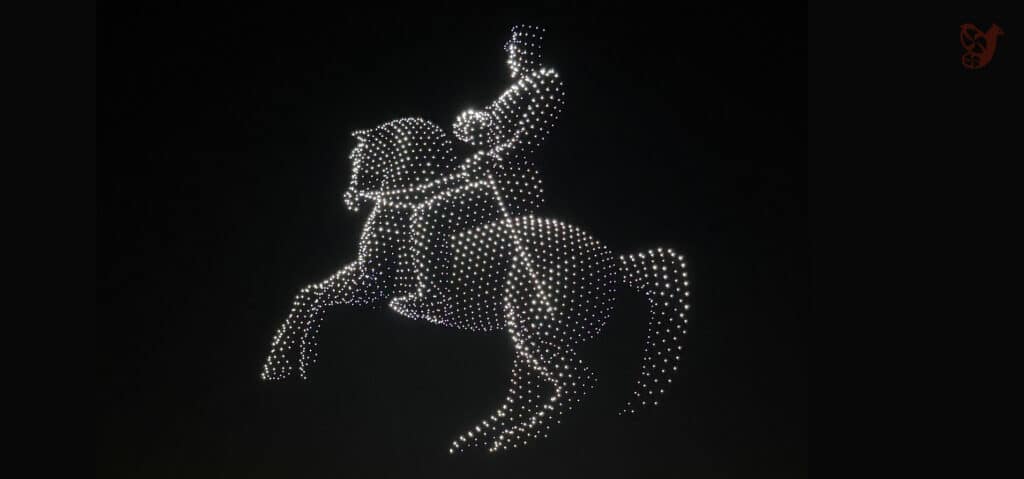
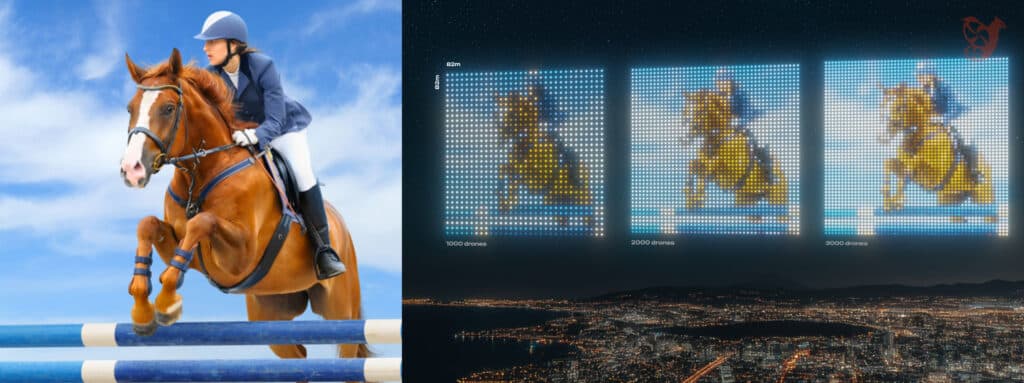
Each drone is a single point of light. To put it simply, it is a pixel in the sky. The more of those pixels there are, the more freedom the designers and animators have: the shape can be rendered more precisely, the detail can be worked out, more complex colour schemes can be used, volume can be added and the scenes can be made more expressive.
When there are few drones, the images inevitably become more spare. That does not mean the show looks worse. On the contrary, projects like these often turn out to be very moving and very memorable. But in texture they are closer to a child’s drawing: a person made of a circle and a few lines, a bird as a single tick mark, a simple flower, a heart, a symbol.
Images like these read easily and work beautifully at weddings, at private events, at small civic events and on intimate branding projects. Expecting fine detail or the accuracy of a portrait from them, though, would not be right.
What changes as the fleet grows
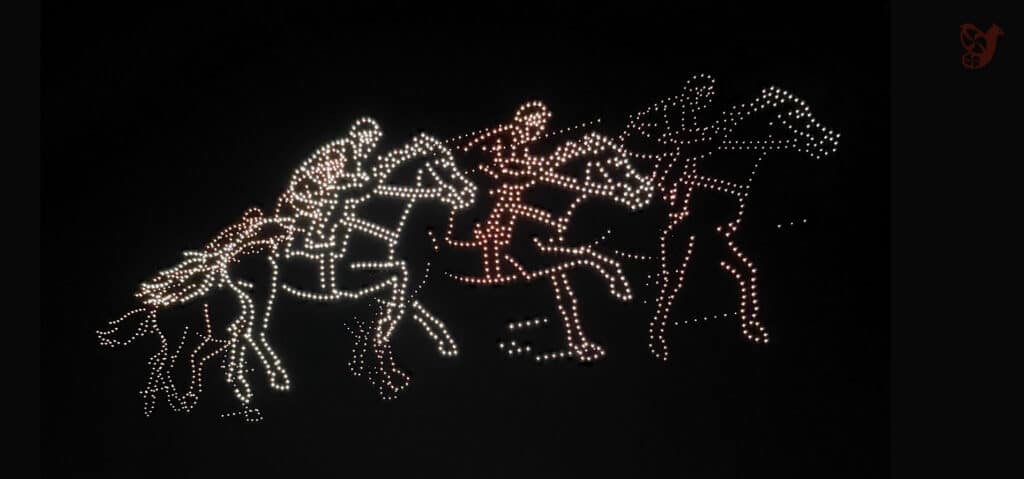
As the number of drones rises, what changes is not only the scale of the image but the level of finish it can be given. Smooth lines become possible, and complex shapes and colour transitions. The bird acquires the movement of a living thing and gains depth, the flower becomes a full composition with petals and shades and familiar characters stop reading as approximate silhouettes and start reading as figures with personality and detail.
This is particularly noticeable in portraits. Here it is not enough simply to suggest a person. The likeness has to be there: the proportions of the face, the outline, the hair and the other distinctive features. Which is why portrait compositions usually begin to look convincing at 1,000 drones and above. That number allows the team to work not just with a silhouette but with the image of a particular person.
Text is the hard part, and few clients expect that
Text deserves attention of its own. At first glance it can seem that putting up a line of writing is simpler than creating a complex animation. In practice it is often the other way round.
For a single letterform to read well, it needs a certain number of drones. As a rule, allow 15 to 20 drones per letter and often more. As long as it is a short word, that rarely becomes a problem. But as soon as the script calls for a long phrase, a greeting, a slogan or text in several languages at once, the number of drones required starts to rise very quickly.
On some projects a single line of text can take more of the fleet than a full animated scene. Particularly if the text has to be not merely visible but neat, easy to read, true to the brand identity and worthy of the event itself.

Logos look simpler than they are, until you read the brief
For the same reason, logos call for particular attention. Many of them look straightforward enough, but once work on the script begins it turns out that the logo has to appear together with the brand name, a slogan or the text element of the brand identity.
At that moment it is the text that starts to determine the size of the whole composition.
The letters cannot be too small, or the audience simply will not be able to read them. To keep them legible, the text has to be made larger and the whole logo grows with it. As a result the drones start going not only into the graphics themselves but into maintaining the proportions, the spacing between elements and the balance of the image as a whole.
So a logo that looks simple often makes for a demanding job. Not because the logo is complex, but because the text that has to go with it becomes part of the composition and starts dictating its size.
National symbols and the art of adaptation
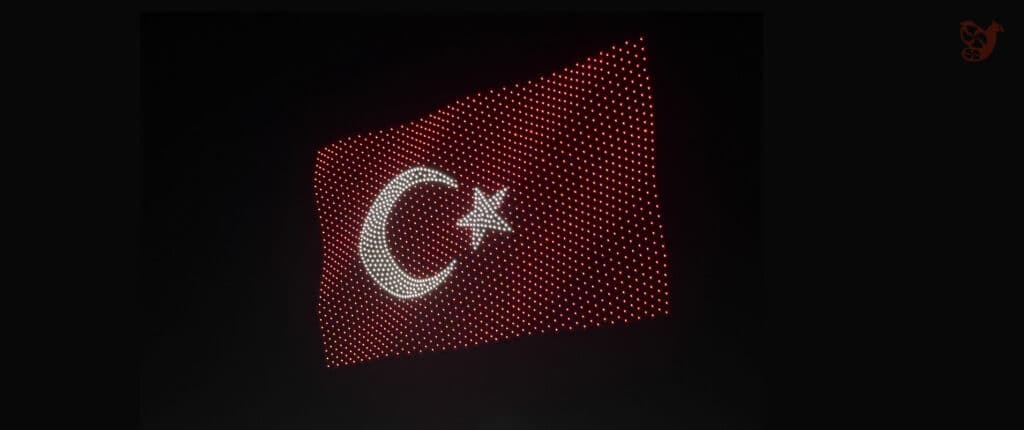
A similar situation arises with national symbols. Some flags are made up of a few simple elements and adapt well to animation in the air. Others contain calligraphy, coats of arms, complex symbols and a great many small details.
So the flag of Saudi Arabia and, say, the flags of France or the Netherlands present entirely different tasks for a team of animators. In the case of France or the Netherlands, a relatively simple composition of colour has to be shown; in the case of Saudi Arabia, the calligraphy and the additional elements have to stay recognisable.
Even with a large number of drones, images like these call for careful artistic adaptation. In practice, in cases like these, the search is for a visual solution that will sit naturally in the sky and keep the symbol recognisable at the same time.
Flat images and volume
The number of drones affects not only the level of detail but what can be done with volume. Smaller shows are more often built around flat images, which the audience reads as a picture on an enormous invisible screen.
A large fleet opens up something else entirely. Three-dimensional figures become possible, and several layers in space, complex transitions, rotations and fully three-dimensional scenes. The image stops reading as a drawing and starts reading as an object in the air.
Depth takes its share of the fleet too. Some of the drones are no longer used to draw a surface but to create depth and spatial structure. So the same number of drones can be used in different ways: either for a flat composition with maximum detail, or for a three-dimensional scene with less of it.
The limit nobody mentions until the site is being prepared
There is one more factor, and it usually surfaces at the stage of preparing the site. It is the physical capacity of the location.
The drones have to be laid out safely, prepared for launch, taken up and then landed. That calls for a launch area of a certain size. Sometimes a site takes 500 drones without difficulty, but for 1,000 there is no longer enough room. The site cannot be extended, extra infrastructure cannot be installed and the configuration of the site itself cannot be changed.
And very often it is the site that becomes the real constraint on the project. Historic waterfronts, narrow beaches, mountain locations, closed venues and areas with restricted access affect the number of drones no less than the creative idea does.
Scale, and the expectations that come with it
The scale of the event should not be forgotten either. For a wedding or a private occasion, a show of a few hundred drones can look impressive and match the guests’ expectations completely. For a major state festival, a national holiday or an event for a well-known international brand, the expectations are usually different.
On projects like these the number of drones becomes part of the overall scale of the production, alongside the stage, the lighting, the screens and the other elements of the show.
There is no universal right answer, only the right fit
So the number of drones on any given project is a balance of several factors at once. The budget, the standing of the event, the character of the site, the text, the logos, the national symbols, the portraits, the 3D animation and the level of detail all come together in the end into a single system.
A strong and moving show can be created with a few hundred drones. A large-scale production can be delivered with a thousand or more. The question in itself is not which number is right. What matters far more is understanding what possibilities the chosen scale opens up, and what expectations come with it.
Sometimes 300 drones are enough to tell an audience a vivid story. Sometimes 1,000 are needed simply to show a logo, a line of text, a portrait or a complex national symbol properly. There are projects where the limits of the site have to be taken into account, and there are tasks where it is precisely a large fleet that allows the move from simple images to full aerial scenography.
Every project has its own sufficient scale
Every project has a level of quality that is sufficient for it.
It is not always the maximum number of drones and not always the minimum. It is the scale at which the idea of the show, the possibilities of the animation, the character of the site, the standing of the event and the budget begin to work together.
Sometimes that can be reached with a few hundred drones. Sometimes it takes a thousand or more. What decides it is what the project has to do and the visual result the audience has to see.
Perhaps the main conclusion is that the number of drones, on its own, says almost nothing about the show to come.
Behind the same figure there can be completely different scripts, different sites, different demands on the animation and different expectations of the audience.
Which is why, when we develop a show, we discuss not only the number of drones but what exactly has to appear in the sky. Because what matters is not the figure itself but the result it makes possible.
For every project, that result will be its own. So will its sufficient quality.