Outdoor radio-controlled airships
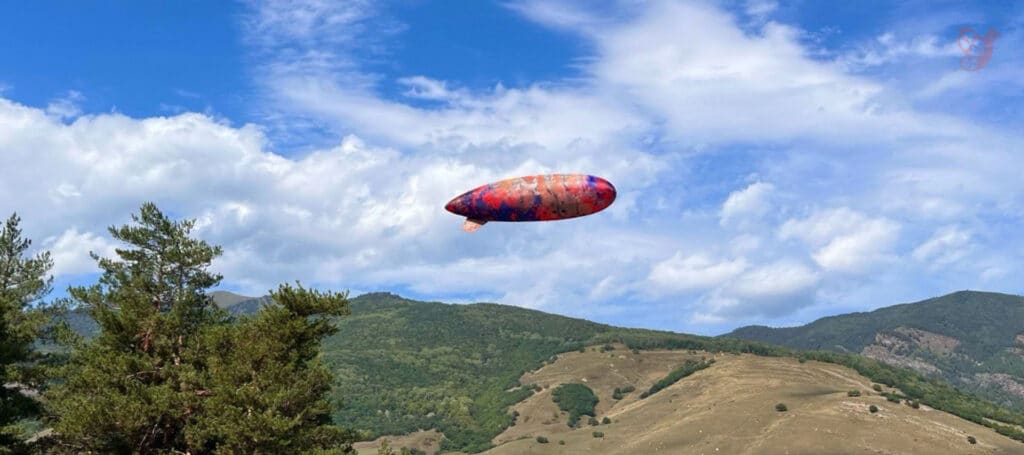
An outdoor radio-controlled airship is an unmanned lighter-than-air craft built to work in open venues and flown by an operator from the ground. It is held up by the lift of the gas inside the envelope. The motors are used not to keep the craft in the air but to move it, turn it and hold its position within the working zone.
That is what makes an airship an effective tool for events in the open. It is easy to see, it can stay in the air for a long time and it can work calmly over the site of the event. Which is why craft like these are used for branding a venue, for wayfinding across large sites, for sponsor integrations and for use as striking visual elements of the scenography.
When an outdoor airship is the right answer
An outdoor airship is particularly effective where a large visual object with a long presence in the air is needed. That may be the branding of a festival, a sporting event or a city celebration, a sponsor integration, wayfinding across a large site, a decorative object in the scenography, a surface for a logo or the shape of a product or simply a highly visible object for photography and filming. On large open sites, ground structures often get visually lost. An airborne object does the same job differently: it marks the space from above, gathers attention and makes the site easier to read.
Flight physics and the logic behind the calculations
Lift comes from the difference in densities. The envelope holds a gas whose density is lower than that of the surrounding air. That produces the buoyant force that lifts the craft.
For a practical understanding it helps to keep one rule of thumb in mind: 1 m³ of helium gives roughly 1 kg of lift. But that is not payload. Out of that reserve you have to subtract the mass of the envelope, the motors, the batteries, the electronics, the fixings and all the equipment on board. What is left forms the usable payload.
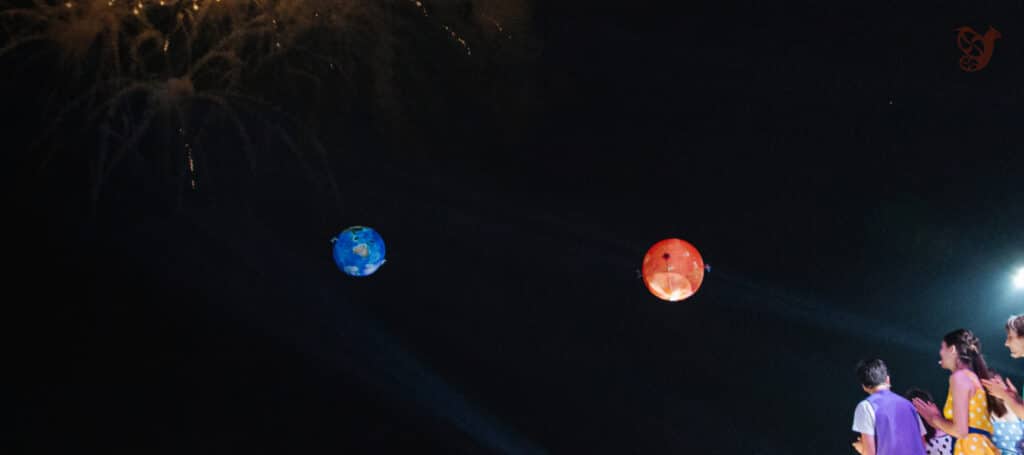
Operation is affected by external conditions too. As the wind strengthens, more energy goes into holding position, so both flight time and usable load are affected. Air temperature and the heating of the envelope in the sun also affect how the craft behaves, which is why proper helium filling and monitoring the state of the envelope over the working day matter for outdoor work.
How the airship is controlled
An airship is moved by thrust; it is not held up by thrust. Several electric motors with propellers are normally used. That arrangement allows it to move forwards and backwards, to turn on to a heading, to hold position within the working zone and to adjust altitude within a certain range.
In practice this means the pilot’s work is not simply flying in a straight line but constantly compensating for drift and controlling the craft’s position relative to the stage, the audience, masts, screens, stands and temporary structures. So what matters to an organiser is not abstract maximum figures but clear controllability at that particular site and in that particular weather.
An airship’s speed is comparatively low. It is not a tool for dynamic manoeuvres. Its normal mode is calm movement and a long presence in the air. Which is exactly why it works so well as a branded and decorative object, an element of wayfinding and a highly visible accent in an open space.
Why size becomes an operational parameter outdoors
Outdoor tasks call for craft of substantial volume. Size here matters not only visually but technically. A large volume gives more lift, allows a margin in payload, allows more powerful motors to be fitted and produces steadier behaviour across the working range of conditions. At the same time a large object reads better at a distance, which means it works more effectively on large sites and at mass events.
For the outdoor class, craft around 10 to 13 metres long are typical. A practical benchmark for this segment is an airship about 12 metres long. That size allows enough helium to be carried for stable flight and a propulsion system with a good margin of thrust to be fitted, and it gives a highly visible airborne object that reads not only from beside the stage but from distant viewing points as well.
As size grows, so does the surface the wind can push against. So any increase in size always calls for enough thrust in reserve, sound aerodynamics, strict discipline on weather limits and a properly organised working zone. From a producer’s point of view the logic is simple: the right size is chosen not on the principle that bigger is better, but by asking which size reliably does the job in the weather typical of that particular site.
Typical technical parameters of the outdoor class, around 12 metres
- length of the order of 12 m
- payload of the order of 3 to 4 kg, depending on the configuration and the trim
- endurance in the air is normally 60 minutes or more on one set of batteries; as the wind strengthens, that time shortens
- an envelope of high-strength polyurethane film, in practice around 125 microns
- natural helium losses are treated as normal and depend on the material, the seams, the temperature and how the craft is stored
- it is important to distinguish lifting capacity, meaning the total reserve of lift, from operational payload, meaning the weight the craft can carry steadily while holding its zone, staying controllable and flying for as long as required
Wind and operating modes
The governing factor outdoors is the wind. And what counts is not only the average speed but the gusts, the direction, the layout of the site and local turbulence. To keep the figures unambiguous, it helps to separate three operating modes.
- comfortable mode, up to 3 to 4 m/s. In these conditions the airship holds its zone confidently, flies calmly and shows its strengths in full
- working mode, average wind up to roughly 7 to 9 m/s. The equipment remains entirely usable, but it already calls for closer assessment of the site, the gusts and the trajectories
- tolerable short gusts, up to 12 to 15 m/s. This is not the baseline scenario for an event but a measure of the technical margin of the class, with higher demands on piloting, on the flight zone and on the way the sequence is staged
It is important to understand that a forecast and the real picture on site are not the same thing. Stages, stands, screens, trees, pavilions, buildings and changes in ground level create local eddies, shifts in the flow and gusts. So the decision to fly is taken not on a weather service alone but on actual measurements and the real situation on the ground. The same forecast means something quite different in an open field and in a built-up area when it comes to working in the air.
Small shapes outdoors

Small shapes outdoors have their own clear niche. We are talking about very particular objects, a radio-controlled sphere 2 metres in diameter, for example. Shapes like these can be used as an airborne visual element, a wayfinding object or a lightweight branded surface at open venues.
For small shapes the weather and the layout of the site matter especially. For a 2-metre radio-controlled sphere the working wind range outdoors can reach 5 m/s, while the most comfortable operation is usually in the range of 2 to 3 m/s. And the result is noticeably affected not only by the average wind speed but by gusts, turbulence and the proximity of stage structures, stands, screens and buildings.
So small shapes work best where the task is clear, the route is controllable and the weather window has been assessed in advance. In those conditions a 2-metre sphere or a comparable small shape becomes a fully fledged outdoor tool for local visual work, for branding and for wayfinding. In some cases, thin safety tethers can also be used if the script depends on the object staying in one fixed zone for a long time.
A large outdoor airship and a small sphere do not compete with each other. They do different jobs. A 12-metre airship is needed where scale, long-distance readability, a margin of stability and a long presence in the air matter. A sphere of around 2 metres suits a local accent, pinpoint branding, wayfinding or a light visual object in one particular area.
Safety and behaviour in the air
One of the key advantages of an airship comes from its physical nature. It is a lighter-than-air craft whose structure is mostly a soft envelope and gas. Even if power or control fails, it does not fall the way a drone does; it keeps its lift and drifts gradually with the airflow. That is exactly what makes its behaviour gentler and more predictable.
Safety here is provided not by one characteristic but by a combination of the physics of the craft, the operating procedure, the chosen flight zone and an actual assessment of the weather on site. In practice the focus is not on the risk of falling but on control of the space. The working flight zone has to be defined in advance, possible drift with the wind has to be allowed for, distance has to be kept from stage structures, masts, screens and other objects and the work has to be done with an experienced pilot and with clear launch and landing procedures. With the operation properly organised, an airship gives a striking airborne effect with a calm and predictable pattern of behaviour in the air, which is particularly valuable at live events with an audience and complex scenography.
What should be settled with the venue in advance
For an outdoor airship to work calmly and predictably, several questions are better settled before the day of the build.
- whether there is a safe area for preparation and filling
- where exactly the launch will take place and where the landing is planned
- whether there are restrictions on altitude or on the airspace regime
- what stages, masts, screens, trees, stands and other tall or bulky objects are nearby
- what wind conditions are typical for the site hour by hour, and what the actual situation on site shows
- whether there is a fallback plan if conditions move outside the weather window
- how the finished object will be moved if inflation is not done at the launch point
- whether the passages, gates, doorways and open areas are wide enough for the object to be moved safely
These questions do not always look impressive in a presentation, but they are precisely what makes a project calm and professional to deliver.
How the project decision is made
The professional logic of the choice is simple: the task, the site, the weather, the regulations. It is important to establish in advance what exactly the object is meant to do in the air and how many hours a day it has to work, what wind conditions are expected hour by hour and what the site actually shows, whether there is a safe area for preparation, launch and landing, what restrictions on altitude and airspace apply at the location, and whether a fallback plan is in place if conditions move outside the weather window.
If the answers across that matrix line up, an outdoor radio-controlled airship becomes a predictable and technically straightforward tool.
In conclusion
Outdoor radio-controlled airships are a strong and practical answer for branding, wayfinding and scenography at open venues. For the class of around 12 metres it is worth keeping a clear set of reference points in mind: a length of the order of 12 metres, a payload of about 3 to 4 kg, endurance in the air of normally 60 minutes or more, a comfortable mode up to 3 to 4 m/s, a working mode of average wind up to roughly 7 to 9 m/s and tolerable short gusts up to 12 to 15 m/s with higher demands on the site and on piloting. For small shapes, including spheres of around 2 metres, the logic is different: the comfortable range is usually 2 to 3 m/s and the working range can reach 5 m/s.
Prepared correctly and matched to the right format, an outdoor airship becomes a reliable tool that answers several needs of an event at once: visibility, wayfinding, branding and use of the space. That is where its practical and commercial strength lies for the organiser, for the venue and for the client.