Radio-controlled airships at events: physics, safety and practical use
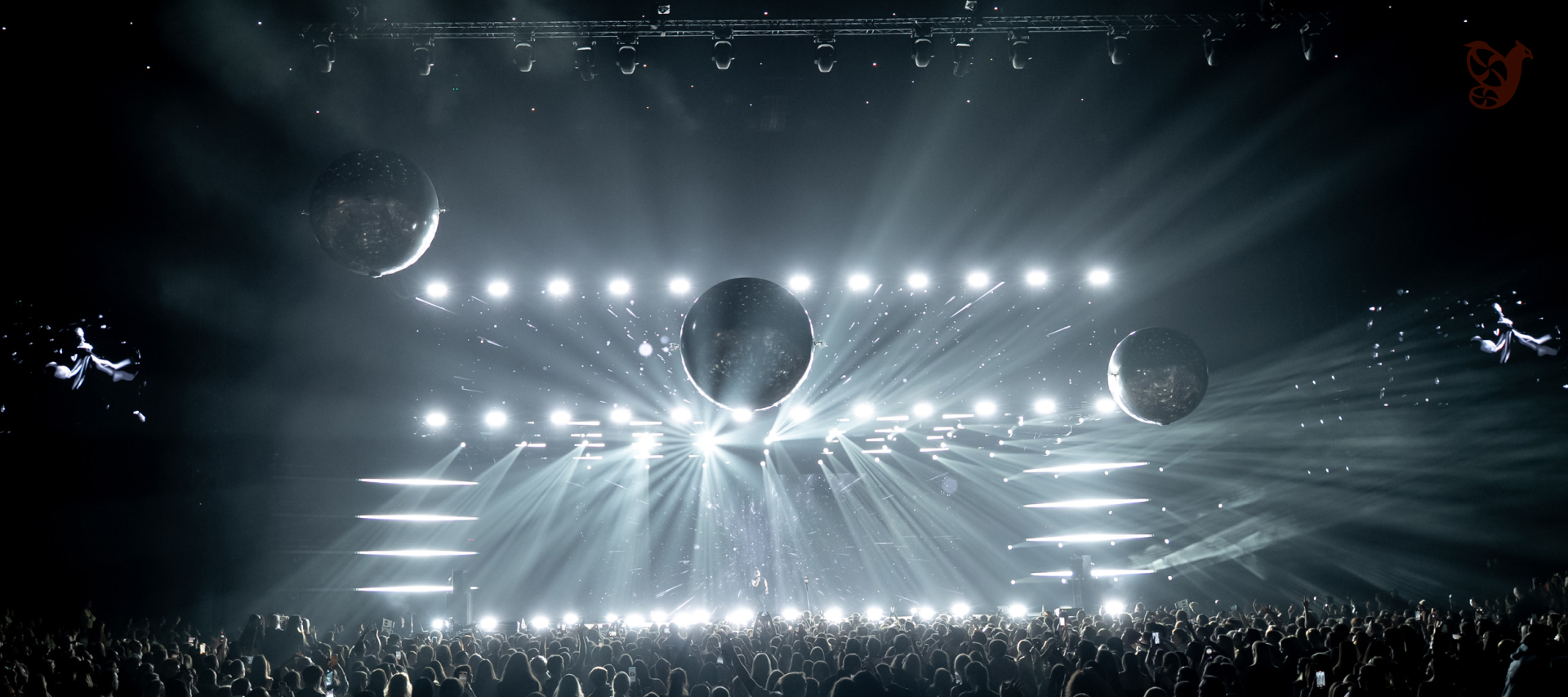
In large venues there is one space that almost always goes unused as a directorial instrument. It is the air above the audience. We are used to the action being on the stage, on the screen and in the lighting plans. So a controlled object in the air captures attention almost automatically. The reason is simple: the audience does not expect content to appear where nothing usually happens. Novelty and surprise here are not an artistic device; they are an observed reaction of an audience to an unfamiliar element in a familiar environment.
From that comes a practical option for a producer: to make the air a second stage. Not as a replacement for the stage or the screen, but as a separate layer that can be switched on when the task calls for it. A narrative object in the air can move through the hall and come closer to the areas usually written off as the far rows. The shapes can be anything, from animals and fantasy characters to rockets and aircraft. What matters is not the shape in itself but the fact that the object changes its position in space under control and so allows the focus of the audience to be moved.
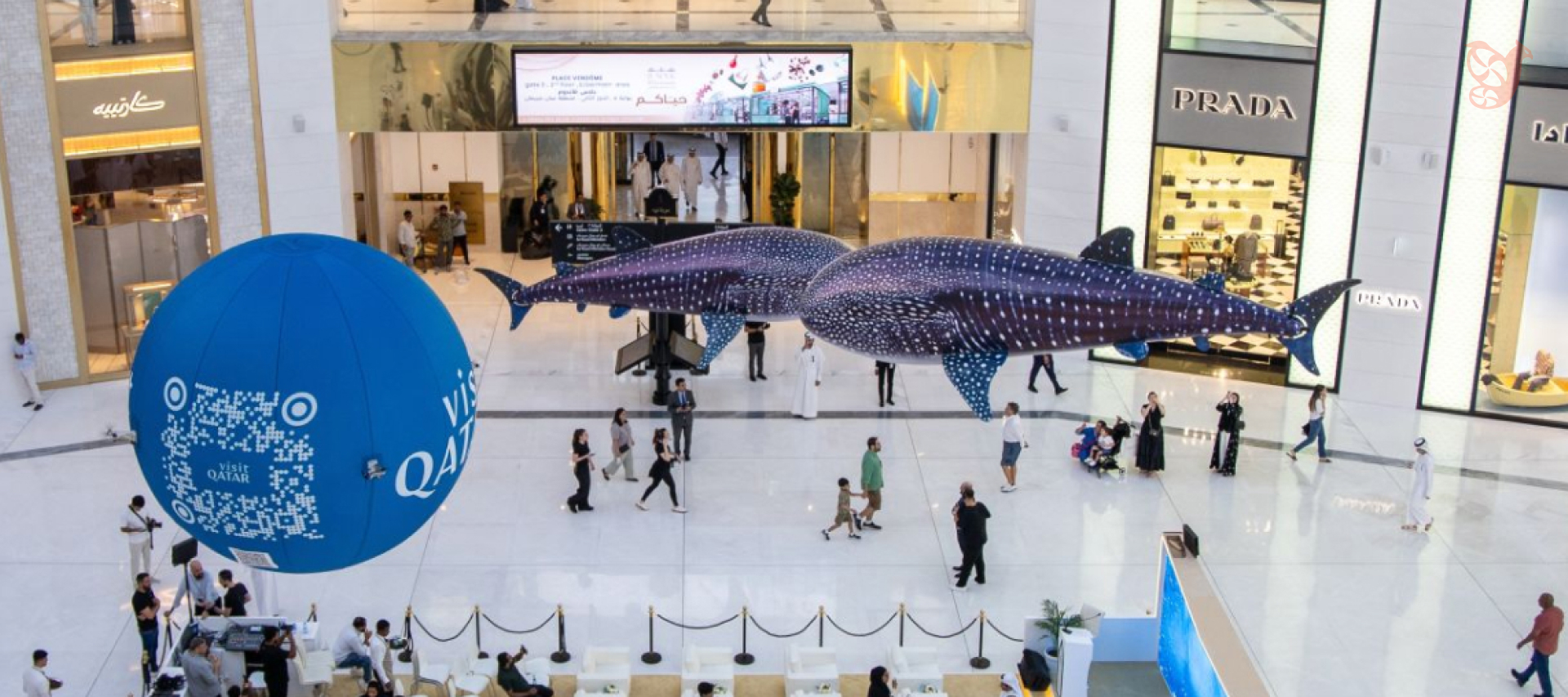
The second group of tasks is advertising and information in the air, in shopping centre atriums, at exhibitions, forums and conferences. The value here is not in a performance but in controlled visibility. An airborne display is visible from different points and different floors; it can change position, hold where the flow of people is heaviest and work as an event-driven information element rather than a static structure. The envelope carries a brand, announcements, wayfinding, QR codes and other short messages. That gives the organiser an instrument which is not tied to walls and window displays and does not depend on the angle from which a person approaches the area.
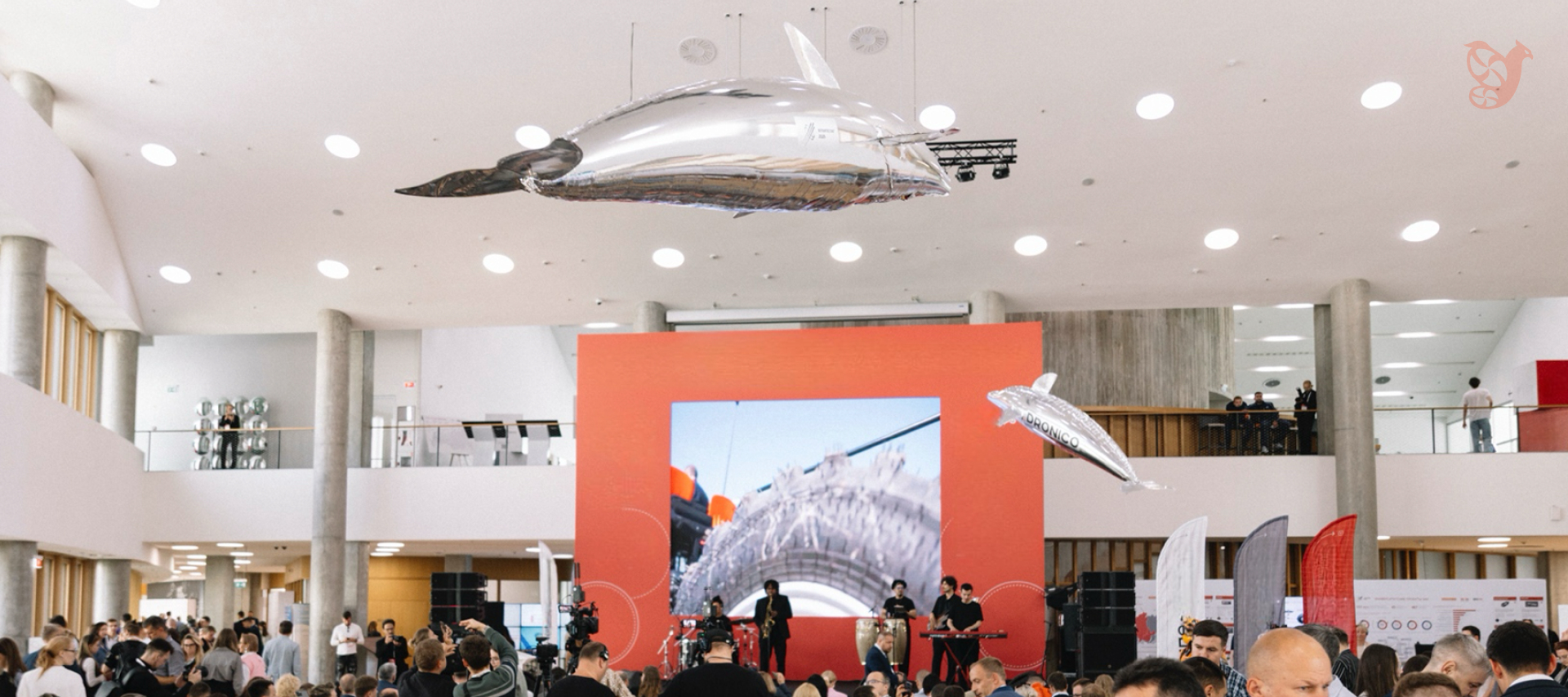
The third group of tasks is flying decorations. When the object becomes an extension of the design, it adds life and movement to the space without complex rigging. The air stops being emptiness and starts working as part of the environment, adding movement where static scenography gives only a picture.
What a radio-controlled airship is from the point of view of physics
An airship indoors is a controlled buoyant system. The envelope holds a gas that is lighter than air, non-flammable and inert: helium. The difference in densities produces lift; the envelope displaces air, and that displaced volume produces an upward force equal to the weight of the air displaced.
There is a simple rule of thumb that keeps this out of the realm of magic. Under normal conditions 1 m³ of helium gives about 1 kg of lift. But that is not payload. Out of that resource comes the mass of the envelope, the power unit, the batteries, the electronics, the fixings, the safety tether if one is used as a technical element at that particular venue, the lighting and the decorative elements. Which is why the key parameter in operation is not the quantity of helium but the balance of buoyancy.
In practice the trim is set close to neutral. That means the airship should not tend to rise sharply or drop sharply without thrust. The propellers and the controls are then used to move along a trajectory and hold orientation, rather than to fight gravity continuously.
Two consequences of this physics matter to an organiser.
- Long presence in the air indoors is possible as a working mode. The motors are needed for movement and correction, not for holding the craft up.
- The main difficulty moves from whether the craft will stay up to how it will behave in air currents and near structures. Indoors the governing factors become the ventilation, the heat curtains, open doorways and local jets of air from equipment and from the stage.
The difference from craft heavier than air, from drones, is that an airship is not held up by continuous thrust. With buoyancy trimmed correctly, it should not drop sharply if propeller thrust is briefly lost. That changes the risk profile and makes it possible to consider flying radio-controlled airships directly above people.
That said, flying over people in the professional sense is always a combination of three things.
- Limited modes of movement. Speed and altitude are chosen for controllability and margin for manoeuvre, not for the beauty of the shot.
- Control of the environment. Indoors the governing factors are the air currents and the limits set by ceiling height or suspended equipment.
- Procedures. When flying a radio-controlled airship the pilot must see the whole trajectory and know about any stage effects that are planned.
Safety and risks
Rather than turn the article into a list of fears, let us set safety out in a producer’s logic: what can realistically derail the plan, and what barriers are put in place at the venue.
The most common sources of trouble indoors are not things falling from above. They are these.
- Air currents and turbulence. If the ventilation changes mode automatically, if there are heat curtains, if gates or doors open, the airship can be pushed off line even under careful piloting. The barriers here are not an experienced pilot but an understanding of the airflow, trajectories chosen with clearance from structures and a test run in the same mode the event will run in.
- Trusses, cables, rigging, decorative elements, sound systems, banner lines all make what we call a ‘dirty ceiling’. Which is where no-fly zones come from, and altitude limits and the principle of not flying where a safe trajectory cannot be guaranteed.
- Contact with a person. In scenarios with visitors the main risk is usually not the envelope but the propeller zone and the unpredictable actions of people: raised hands, props, children, a crowd at the point of interest. The barriers are a speed limit above people, a limit on altitude and propeller guards.
- Loss of the link. This is not a reason to panic, but it is a scenario that has to be set out in advance.
In short, safety indoors is not built on the slogan that the craft is light. It is built on the discipline of a predictable environment and limited modes of movement.
The limits of the technology
Airships open up a new scenographic option, but they need particular conditions. It is worth knowing the limits in advance so that nothing is promised to the director that cannot be delivered properly.
- You cannot ask an airship for the agility of a drone. It is an instrument of smooth movement and controlled presence, not of sharp manoeuvres and work in narrow corridors between set pieces.
- Stage effects have to be agreed. Smoke, confetti and CO₂ change the environment and the pilot’s visibility, and sometimes the mechanics of control as well.
- Tests and rehearsals are needed. Indoors you cannot work properly by eye, because the behaviour depends heavily on the particular venue.
Differences from drones
Arguing over which is better makes no sense. It is useful to compare them by what changes for the organiser.
- A drone stays up on thrust. An airship stays up on the lift of the gas, and thrust is needed for movement and orientation.
- For a drone the main risk in a power problem is loss of position holding. For an airship the main risk is loss of active control near structures.
- For a drone, the restrictions on flying over people are critical. For an airship, ceiling height is critical.
- A drone is stronger in a precise, dynamic pattern. An airship is stronger in long presence, large shapes and work with the second level of the space.
When an airship is the right answer
There are several indications that make an airship the rational choice indoors.
- The upper volume needs to be used as part of the staging, not simply as somewhere to put lights.
- What matters is moving the audience’s attention into the depth of the hall and working with the far rows.
- An event-driven information display is needed in an atrium, at an exhibition or at a forum, visible from different points and floors and able to move between areas.
- Airborne objects are meant to become part of the design and work as flying decorations rather than as a separate act.
When an airship is not suitable
- No clear corridor can be set aside in altitude and route: too much rigging, too many cables, wires and decor, with no way to define no-fly zones.
- The ventilation is unpredictable, and the building’s ventilation and air-conditioning modes cannot be agreed.
- The director needs high speed, sharp manoeuvres or work in tight passages beside the set.
- Stage effects run as a dense background and get in the way of visibility and control.
- There is no time for a test and a rehearsal in the real conditions of the venue.
Radio-controlled airships indoors should therefore be considered not as a kind of drone, which is often banned from flying indoors anyway or as a separate stage effect, but as a class of airborne solution in its own right.
Their physics rests on buoyancy, not on thrust. Properly prepared, an airship can stay in the air for a long time, move through the hall and work with the audience across different levels of the space.
Which is why radio-controlled airships are used today not only as a visual element of a show, but as an instrument of scenography, advertising and spatial communication at events, at exhibitions and in public spaces.